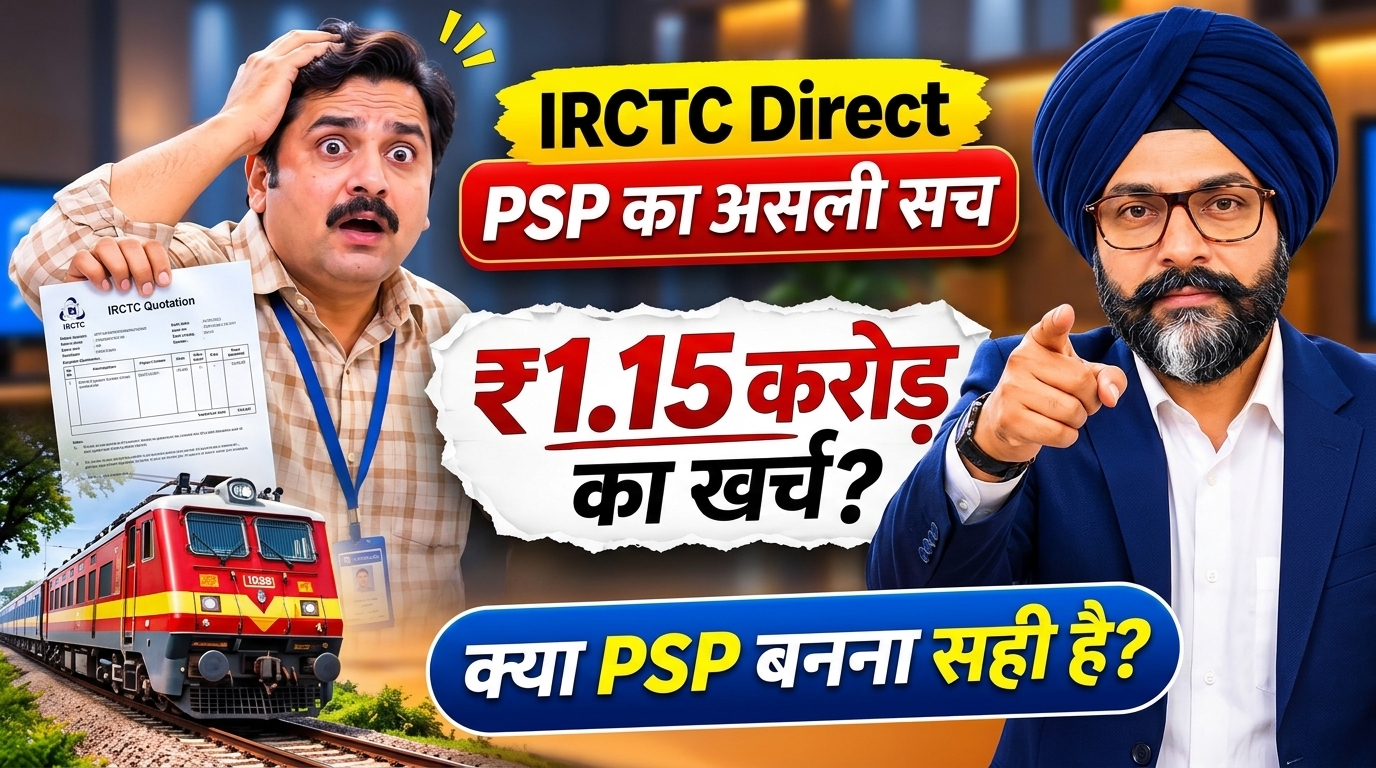
Many retail travel agents wonder why portals charge annual renewal or maintenance fees, often assuming direct PSPs make crores without overhead. In this in-depth guide, we unpack the factual ₹1.15 Crore investment, strict CERT-In and IRCTC compliance rules, and the true economics of running a Direct PSP railway network.
In the railway ticketing ecosystem, many ambitious travel agency owners, B2B aggregators, and fintech startups dream of creating their own independent ticketing portal by connecting directly to Indian Railways. The big question is: How do you become an authorized Direct IRCTC Principal Service Provider (PSP), what are the legal eligibility bars, and is it true that the initial outlay exceeds ₹1.15 Crore?
In this authoritative analysis based on the detailed video briefing by railway industry expert Nihal Singh , we break down IRCTC’s two official licensing models—the Internet Cafe Scheme (ICS) and the enterprise-level B2B Web Services Scheme —covering strict eligibility mandates, complete cost itemization, operational liabilities, and strategic guidance for prospective travel entrepreneurs.
1. The Two Official Licensing Schemes: ICS vs B2B Explained
IRCTC does not grant direct API connectivity to arbitrary individuals or local travel counters. Instead, Indian Railways operates two sanctioned pathways for technology companies wishing to distribute railway tickets across sub-agent networks:
A. Scheme 1: Internet Cafe Scheme (ICS) – The Mid-Tier Network
The Internet Cafe Scheme is tailored for regional IT operators, internet service providers, or small multi-service networks looking to onboard a capped number of local agents without needing deep custom API integrations.
-
Eligibility Mandate: The applying organization must be a legally registered entity with at least 3 continuous years of audited operations.
-
Turnover Requirement: Minimum audited annual turnover of ₹1 Crore per year .
-
Total Initial Capital: Approximately ₹20 Lakhs (inclusive of bundled security deposit, integration package, and applicable taxes).
-
Annual Maintenance Contract (AMC): ₹6 Lakhs + GST per year, which covers quota management for up to 500 sub-agent credentials.
B. Scheme 2: B2B Web Services Scheme – The Enterprise Portal
The B2B Web Services Scheme represents the full enterprise-tier integration. It is designed for major corporate travel aggregators, national fintech portals, and large banking platforms operating custom-built booking interfaces with thousands of active retail agents.
-
Eligibility Mandate: The company must have a proven corporate vintage of at least 3 operating years .
-
Turnover Requirement: Minimum verified audited annual turnover of ₹5 Crores per annum .
-
Total Initial Capital: Approximately ₹1.15 Crore (including ₹25L refundable security deposit, ₹50L integration fee, and ₹30L setup, architecture, and refund gateway development + GST).
-
Annual Maintenance Contract (AMC): ₹5 Lakhs + GST per year for up to 1,000 sub-agent credentials, scaling upward as the network expands.
2. Complete Comparative Breakdown: ICS vs B2B Web Services
To provide complete financial transparency, the following table details the official capital requirements and operational criteria across both schemes:
|
Parameter / Expense Head |
ICS Scheme (Internet Cafe) |
B2B Web Services Scheme |
|---|---|---|
|
Minimum Annual Turnover |
₹1 Crore / Year |
₹5 Crores / Year |
|
Company Vintage |
3 Years Minimum |
3 Years Minimum |
|
Security Deposit (Refundable) |
Bundled in Package |
₹25,00,000 (₹25 Lakhs) |
|
IRCTC Integration Fee |
Standard Package |
₹50,00,000 (₹50 Lakhs) |
|
Architecture, Setup & Refund Gateway |
Basic Included |
₹30,00,000 (₹30 Lakhs) |
|
Total Initial Outlay (with GST) |
~ ₹20,00,000 (₹20 Lakhs) |
~ ₹1,15,00,000 (₹1.15 Crore) |
|
Annual IRCTC AMC Fee |
₹6 Lakhs + GST (500 IDs) |
₹5 Lakhs + GST (1,000 IDs) |
3. Core Operational Responsibilities of a Direct PSP
Securing the license and paying the ₹1.15 Crore integration cost is merely the first step. Operating a direct railway gateway involves significant ongoing technical, legal, and operational commitments:
A. Dedicated Cloud Infrastructure & Static IP Whitelisting
A PSP cannot operate on shared commercial hosting. IRCTC mandates dedicated, high-availability server clusters with fixed, whitelisted Static IP addresses and high-bandwidth redundant connections to handle intense peak-load traffic during General and Tatkal opening minutes.
B. CERT-In Cybersecurity Auditing
Before connecting to production railway reservation servers, the portal’s source code, data storage architecture, payment processing pipelines, and server operating systems must undergo a comprehensive cybersecurity audit conducted by a CERT-In empaneled agency. Any vulnerability must be patched and re-certified annually.
C. Mandatory Sub-Agent KYC & Verification
The PSP is legally responsible for verifying the authenticity of every retail agent (RSP) on its platform. This includes digital PAN validation, biometric or Aadhaar OTP authentication, physical business premises verification, and digital record archival.
D. Legal Liability for Sub-Agent Fraud
This is one of the highest risks in the PSP business model. If even a single retail agent on the PSP network uses unauthorized software, third-party automation tools, or illegal scripts to manipulate ticket bookings, IRCTC directly penalizes the PSP company. Penalties range from heavy financial fines (₹1 Lakh to ₹25 Lakhs) to the permanent blacklisting and suspension of the entire portal.
E. 24x7 Helpdesk & Technical Support
PSPs must maintain a dedicated, round-the-clock technical and support desk to manage instant PNR inquiries, handle failed transaction reconciliation, process Ticket Deposit Receipt (TDR) refund follow-ups, and deliver OTP assistance to agents nationwide.
4. PSP vs RSP: Which Route is Right for Your Business?
Understanding the fundamental economics of railway ticketing helps entrepreneurs evaluate the right entry point:
-
When Direct PSP Makes Sense: If an organization has established tech teams, multi-crore working capital, in-house compliance infrastructure, and an existing distribution network of 2,000+ active agents capable of booking tens of thousands of tickets monthly to reach break-even over 3 to 4 years.
-
When Becoming an RSP (Retail Agent) is the Smarter Path: For individual travel agents, small business owners, CSC operators, and tour agencies, becoming an Authorized IRCTC Retail Service Provider (RSP) through an existing licensed PSP is overwhelmingly the more practical and profitable choice. With a minimal startup investment of a few thousand rupees, zero server costs, and no enterprise compliance risks, retail agents earn the full authorized ₹20 (Non-AC) and ₹40 (AC) commission on every ticket booked from Day 1.
💡 Editorial Insight: The High-Volume Reality
The direct PSP business model relies entirely on massive ticket volume and thin payment gateway margins of mere paisas per booking. For 99% of travel professionals, working as an authorized retail agent delivers substantially higher returns on investment without the multi-crore liabilities, technical audits, or regulatory penalties associated with operating a direct portal.
Watch & Connect on Social Media
Follow this topic on our official social channels
Have questions about IRCTC authorized agent rules, ID onboarding, or compliant railway ticket booking operations? Our team helps travel businesses stay updated and compliant.